Joseph Clark Collection
Phyllida Barlow – Untitled: Grinder (2014)
A 2014 study drawing for Phyllida Barlow's installation Grinder, carrying the restless energy and structural tension that defined her anti-monumental sculptural practice.
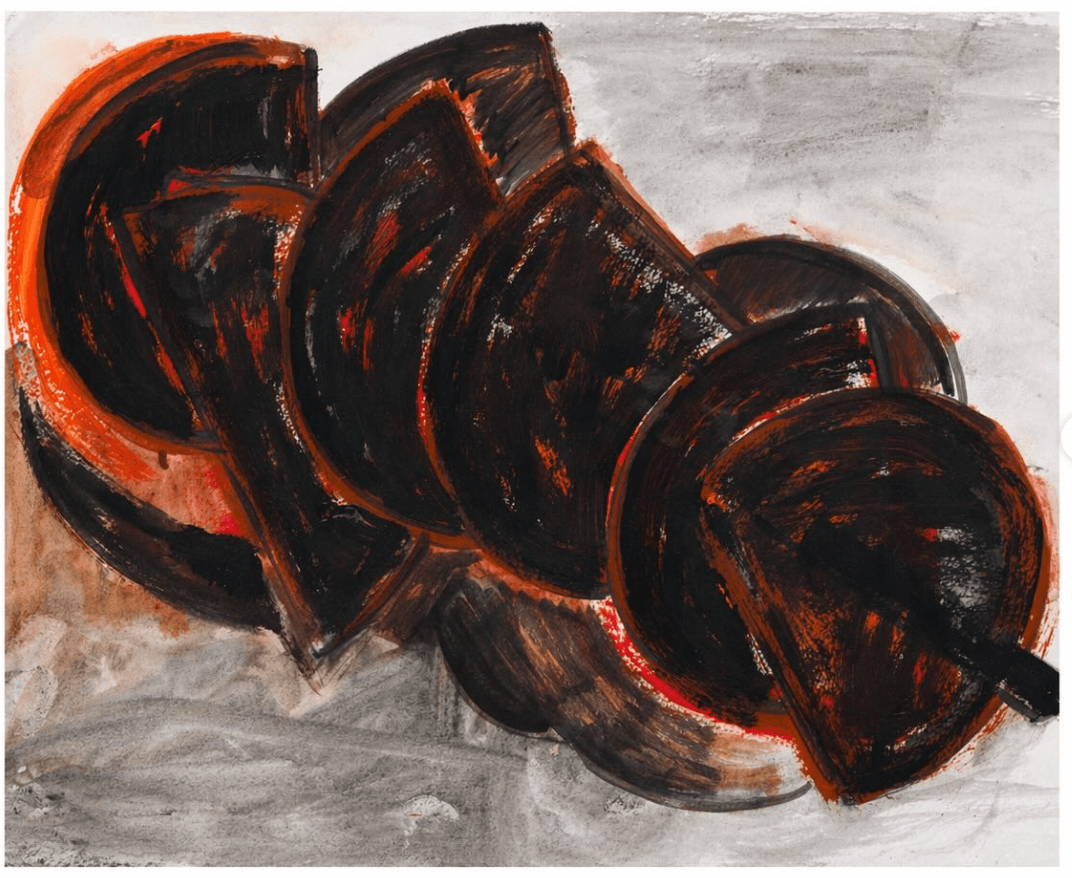
What draws Joseph Clark to the work is the tension between apparent structure and inevitable erosion. The drawing captures a moment of thinking, testing, and constructing something that may or may not hold.
About the artist
Phyllida Barlow (1944–2023) was one of the most influential British sculptors of the contemporary era, celebrated for monumental installations that transformed ordinary materials into emotionally charged environments of tension, instability, and physical presence. Working with plywood, cardboard, fabric, plaster, cement, timber, paint, and industrial debris, Barlow developed a sculptural language that embraced imperfection, provisionality, collapse, and excess. (Tate)
Although widely respected within artistic circles for decades, Barlow achieved major international recognition later in her career, culminating in representing Britain at the 57th Venice Biennale in 2017. Her work fundamentally challenged traditional ideas of monumentality, permanence, and sculptural authority, instead foregrounding process, fragility, improvisation, and physical labour. (British Council)
About the artwork
Untitled: Grinder (2014) is a study drawing connected to Barlow's installation Grinder, presented as part of Phyllida Barlow: GIG at Hauser & Wirth Somerset in 2014. Executed in acrylic on watercolour paper, the work captures the restless energy and structural tension that defined Barlow's sculptural practice.
Even at the scale of a drawing, the composition conveys mass, instability, movement, and resistance. Sweeping dark forms press against the lighter ground, suggesting structures that are simultaneously being built, tested, and threatened by collapse. The work operates not simply as preparation for sculpture, but as an independent extension of Barlow's thinking process, where gesture, materiality, and spatial tension remain central. (Hauser & Wirth)
Throughout her career, Barlow treated drawing as an active and experimental part of sculptural development. Her sketches and studies often carried the same sense of immediacy, weight, improvisation, and precarious balance found in her large-scale installations. Rather than functioning as polished plans, these works preserved the instability and provisional logic central to her practice. (Royal Academy)
Material, weight, and instability
Barlow's work consistently explored the emotional and psychological power of physical matter. Her sculptures often appeared awkward, excessive, fragile, or temporarily assembled, resisting the polished permanence traditionally associated with monumental sculpture.
This tension between structure and collapse became one of the defining characteristics of her work. Materials were stacked, bound, suspended, painted over, or forced into improbable relationships, creating environments that felt simultaneously playful and threatening. In drawings such as Untitled: Grinder, those same concerns emerge through compressed gestures and shifting forms.
Critics frequently described Barlow's installations as anti-monumental. Rather than celebrating stability or control, her work foregrounded uncertainty, entropy, exhaustion, and the visible traces of making itself. (Artsy)
Artistic significance
Phyllida Barlow's work fundamentally reshaped contemporary sculpture by rejecting refinement in favour of immediacy, vulnerability, and material confrontation. Her installations often appeared unfinished or temporary, yet possessed immense emotional and architectural force.
Works such as Untitled: Grinder reveal how central drawing was to this process. Rather than documenting resolved ideas, the work captures sculpture in a state of emergence, uncertainty, and negotiation. The tension between apparent structure and inevitable erosion becomes the core emotional condition of the image.
This sense of provisionality remains one of the defining achievements of Barlow's practice. Her work resists closure, stability, and permanence, insisting instead on sculpture as something alive, unstable, and continuously in flux.
Historical context
The year 2014 marked an important moment in Barlow's international recognition. Phyllida Barlow: GIG at Hauser & Wirth Somerset became one of her most celebrated large-scale exhibitions, occupying both gallery and architectural space with sprawling sculptural interventions. The exhibition demonstrated her extraordinary ability to transform industrial materials into immersive psychological and spatial experiences. (Hauser & Wirth)
Following Barlow's death in 2023, renewed attention was given to her drawings, process works, and studio methodology. Untitled: Grinder was later exhibited in Phyllida Barlow: unscripted at Hauser & Wirth Somerset between 2024 and 2025, curated by Frances Morris. The exhibition surveyed six decades of practice and highlighted the iterative, experimental, and deeply physical nature of Barlow's artistic language. (Hauser & Wirth)
Provenance and attribution
- Study drawing for Barlow's installation Grinder.
- Exhibited in Phyllida Barlow: unscripted, Hauser & Wirth Somerset, 2024 to 2025.
- Courtesy: Hauser & Wirth and The Joseph Clark Collection.
- © The Phyllida Barlow Estate.
External sources
References
- Tate artist overview and biography (tate.org.uk)
- Hauser & Wirth exhibition materials for GIG and unscripted (hauserwirth.com)
- British Council Venice Biennale profile (britishcouncil.org)
- Royal Academy artist profile (royalacademy.org.uk)
- Artsy editorial essay on Barlow's sculptural practice (artsy.net)
Image credits
- Untitled: Grinder (2014), acrylic on watercolour paper. Photo: Alex Delfanne.