Joseph Clark Collection
Louise Bourgeois – Untitled (1998)
A late-period drawing by Louise Bourgeois — abstract, psychologically charged, and tied to the vocabulary of memory, fragility, and the body that defined her practice.
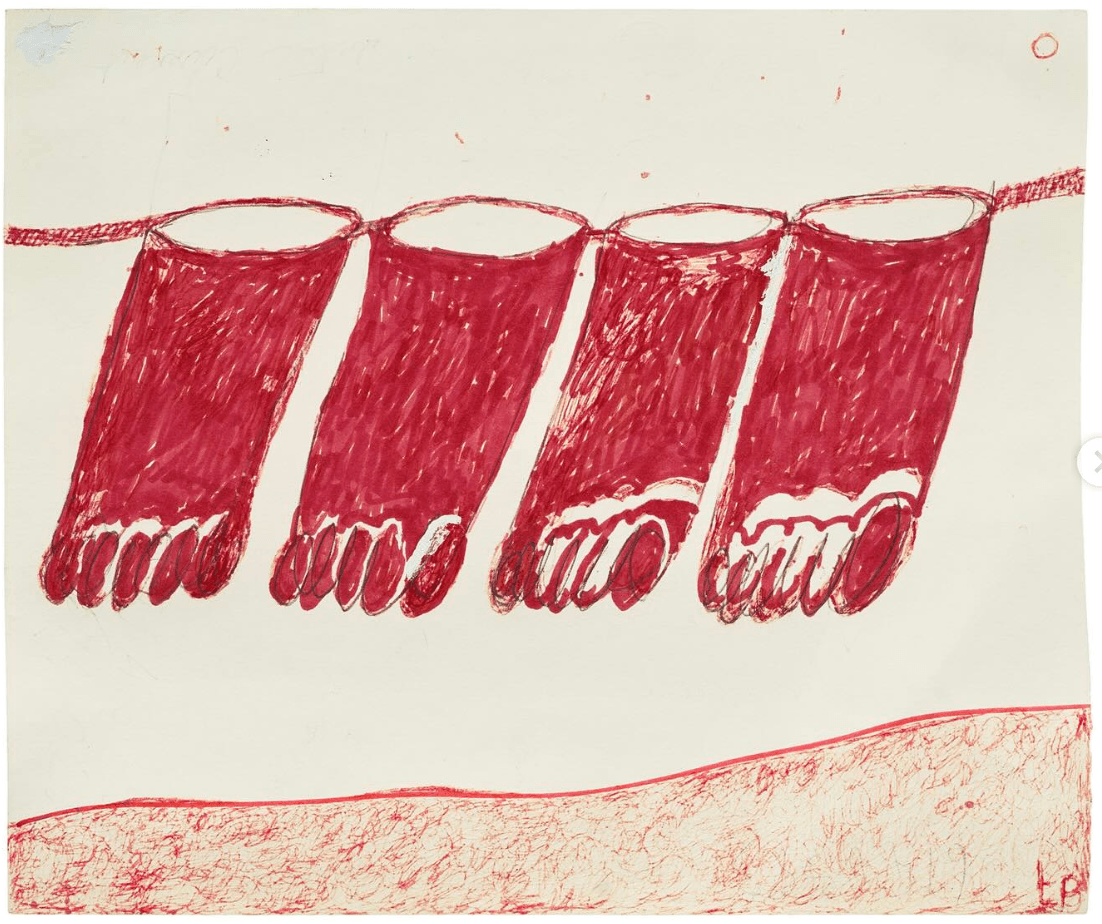
Held in The Joseph Clark Collection as part of a wider engagement with artists whose practices balance personal intensity with formal restraint.
About the artist
Louise Bourgeois (1911–2010) was one of the most influential artists of the twentieth century, celebrated for her deeply autobiographical sculptures, drawings, textiles, and installations. Born in Paris and later based in New York, Bourgeois explored themes of memory, trauma, sexuality, family relationships, anxiety, femininity, and the subconscious throughout a career spanning more than seven decades. She is best known for monumental works such as Maman and her psychologically charged Cells series. (Tate)
About the artwork
Untitled (1998) reflects Bourgeois's recurring interest in abstraction as a language for emotion and psychological expression. During the 1990s, Bourgeois produced a large body of drawings, mixed media works, and installations that used repetitive forms, symbolic marks, organic shapes, and personal iconography to communicate states of vulnerability, fear, intimacy, and memory. (Cleveland Museum of Art)
Many works from this period feature fragmented compositions, bodily references, textile-inspired structures, and geometric arrangements that balance order with emotional tension. Bourgeois frequently connected her visual language to her childhood experiences growing up in her family's tapestry restoration business in France. The themes of weaving, repair, repetition, and fragility became central metaphors throughout her practice. (Cleveland Museum of Art)
Her late 1990s works are particularly significant because they coincide with the development of her acclaimed Cells installations and a renewed international recognition of her work. These pieces often blur the boundaries between drawing, sculpture, architecture, and psychological space. Bourgeois described art as a form of emotional release and self-analysis, stating that her work emerged from lived experience and unresolved memory. (Tate)
Style and themes
Often associated with
- Feminist art
- Surrealism
- Confessional art
- Psychological abstraction
- Installation and conceptual art
Themes explored
- Motherhood and family dynamics
- Fear, anxiety, and trauma
- The body and sexuality
- Protection and vulnerability
- Memory and childhood
- Domesticity and identity
Although Bourgeois resisted being defined solely as a feminist artist, her work became hugely influential within feminist art history because of its uncompromising exploration of female experience and psychological complexity. (Wikipedia)
Historical context
By 1998, Bourgeois had become internationally recognised following major retrospectives and institutional exhibitions, including the landmark 1982 retrospective at the Museum of Modern Art in New York, the museum's first retrospective dedicated to a female artist. Her later career saw growing critical and commercial recognition, culminating in major public commissions and international exhibitions. (Wikipedia)
Works from this period are highly sought after by collectors and museums, with Bourgeois regarded as one of the defining artists of modern and contemporary art. Her influence can be seen across sculpture, installation art, textile art, and contemporary feminist practice.
Provenance and attribution
- Courtesy: The Joseph Clark Collection and Phillips.
- © The Easton Foundation.
- Part of Bourgeois's late-period works on paper, developed alongside her Cells installations.
External sources
References
- MoMA Collection: Louise Bourgeois, Untitled (1998) (The Museum of Modern Art)
- Tate: The Art of Louise Bourgeois (Tate)
- Cleveland Museum of Art: Untitled analysis (clevelandart.org)
- Sotheby's essay on Bourgeois's late 1990s works (Sothebys.com)
- National Galleries of Scotland artist overview (nationalgalleries.org)
- Louise Bourgeois biography and historical context (Wikipedia)