Joseph Clark Collection
Glenn Ligon – Study for the White Series (1995)
A work from Glenn Ligon's mid-1990s White Series, where layered text moves between legibility and abstraction to address invisibility, erasure, and perception.
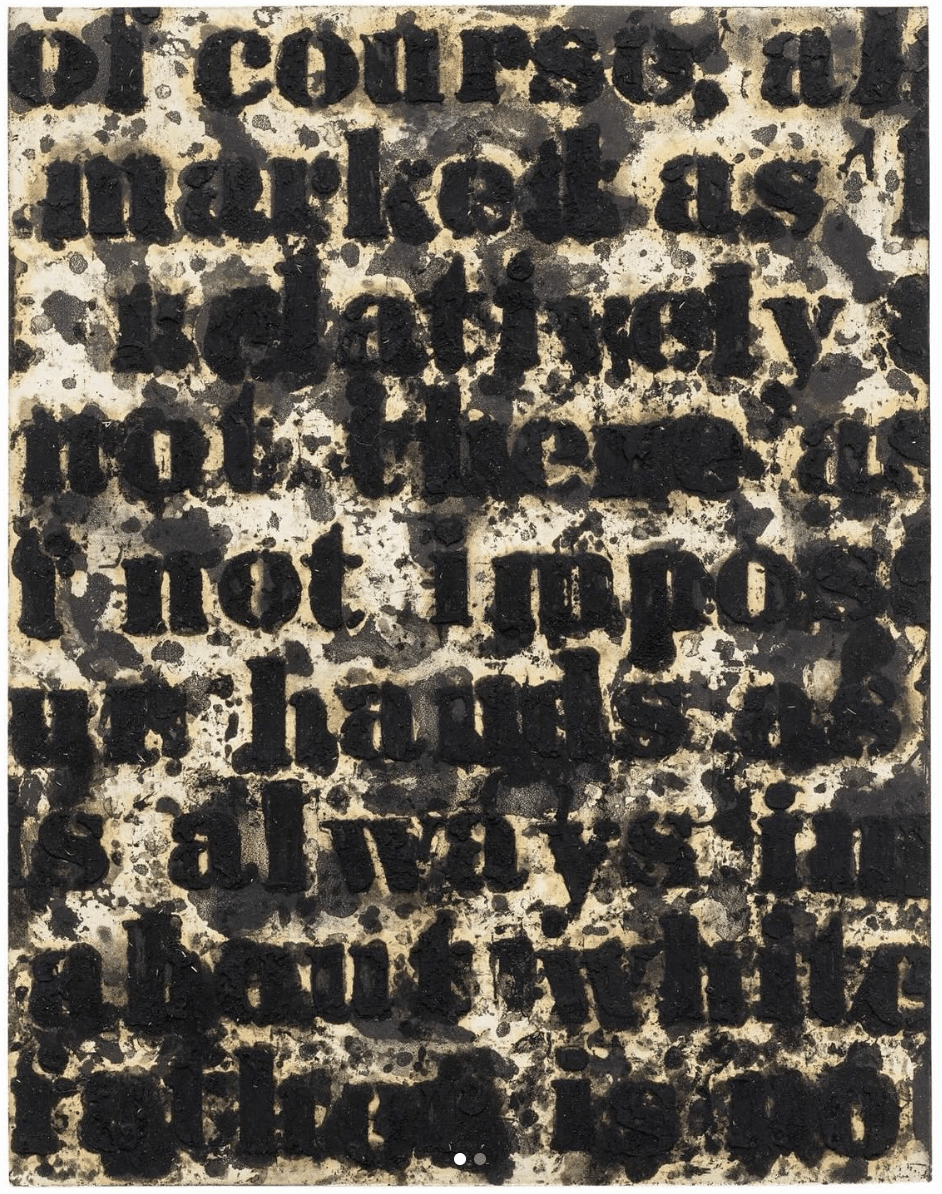
Held in the Joseph Clark Collection for its articulation of visibility, identity, and conceptual language. Ligon does not resolve the instability of the work; he holds it.
About the artist
Glenn Ligon (b. 1960) is one of the most important contemporary American artists working today. Based in New York, Ligon's practice explores race, language, sexuality, history, representation, and identity through painting, drawing, neon, photography, printmaking, sculpture, and installation. His work frequently draws on literature, philosophy, and cultural criticism, using text as both image and political material. (Guggenheim)
Emerging during the late 1980s and early 1990s alongside artists such as Lorna Simpson, Felix Gonzalez-Torres, and David Hammons, Ligon became closely associated with a generation of artists interrogating American identity, visibility, and systems of power. His work is held in major international collections including the Museum of Modern Art, Whitney Museum of American Art, Tate, and the Art Institute of Chicago. (MoMA)
About the artwork
Study for the White Series (1995) belongs to one of Ligon's most significant bodies of work, in which language becomes both communicative and unstable. Executed in oilstick on paper, the work uses layered text that shifts between legibility and abstraction, drawing viewers into a process of reading that simultaneously resists clarity.
The White Paintings and related studies from the mid-1990s marked an important evolution within Ligon's practice. Unlike his earlier black-on-white text paintings, these works use pale surfaces and partially obscured language to explore invisibility, erasure, whiteness, silence, and perception itself. (SFMOMA)
Ligon frequently sourced text from writers such as James Baldwin, Zora Neale Hurston, Jean Genet, Ralph Ellison, and Richard Pryor. Through repetition and accumulation, language in his work often becomes increasingly difficult to decipher, transforming written speech into texture, rhythm, and abstraction. This tension between readability and disappearance is central to the emotional and political force of the work. (Tate)
Language, visibility, and identity
As a Black queer artist, Ligon has consistently explored how identity is shaped through systems of representation and social visibility. In works such as Study for the White Series, text becomes a metaphor for both presence and concealment. Meaning remains partially accessible but never fully fixed.
This instability is intentional. Ligon's work resists simplified interpretation, instead asking viewers to confront ambiguity, projection, and the limits of perception. The surface of the work operates simultaneously as image, language, and conceptual space.
Critics have often connected these works to broader conversations around race in America, the politics of visibility, queer identity, and the instability of language itself. Ligon has described language as something that can both reveal and fail us, particularly when attempting to articulate experiences shaped by marginalisation and history. (Art21)
Artistic significance
Ligon's text-based works are widely regarded as landmarks of contemporary conceptual art because they collapse distinctions between reading and looking, abstraction and narrative, politics and aesthetics.
The White Series occupies a particularly important place within his oeuvre because it pushes language toward disappearance rather than declaration. The works do not offer stable conclusions or singular meanings. Instead, they create a space where identity, visibility, and interpretation remain fluid and unresolved.
Historical context
By 1995, Glenn Ligon had already established himself as a major voice in contemporary conceptual art. The period saw increasing institutional recognition of his work, including exhibitions at the Whitney Biennial and later the Venice Biennale, where he represented the United States in 2015.
The mid-1990s works are especially important because they coincide with broader debates around multiculturalism, identity politics, queer visibility, and postmodern theory within contemporary art. Ligon's practice became central to discussions around how conceptual art could engage directly with race, history, and lived experience without abandoning formal experimentation.
Provenance and attribution
- Courtesy: The Joseph Clark Collection and Phillips.
- © Glenn Ligon.
- Part of Ligon's mid-1990s White Series, related to The White Paintings.
External sources
References
- Tate: Glenn Ligon artist overview (tate.org.uk)
- MoMA artist profile and collection works (moma.org)
- Art21 interview and thematic overview (art21.org)
- SFMOMA artist profile and institutional history (sfmoma.org)
- Guggenheim Museum biography (guggenheim.org)
- Venice Biennale artist information (venicebiennale.britishcouncil.org)